Comparing the Fuel Economy of All 2026 GMC SUVs
GMC’s 2026 SUV lineup spans three distinct sizes, each engineered for different needs. The compact Terrain returns 9.9 L/100 km city and 8.9 L/100 km highway in AWD form. The mid-size Acadia posts 12.1 L/100 km city and 10.1 L/100 km highway. The full-size Yukon – with standard 5.3L V8 – rates at 15.8 L/100 […]
GMC’s 2026 SUV lineup spans three distinct sizes, each engineered for different needs. The compact Terrain returns 9.9 L/100 km city and 8.9 L/100 km highway in AWD form. The mid-size Acadia posts 12.1 L/100 km city and 10.1 L/100 km highway. The full-size Yukon – with standard 5.3L V8 – rates at 15.8 L/100 km city and 12.2 L/100 km highway. If you’re weighing size against fuel costs, the numbers tell a clear story: moving up in capability means accepting higher consumption, but the gap narrows on the highway.
2026 GMC SUV Fuel Economy Ratings
The Terrain’s 1.5L turbocharged four-cylinder delivers the most efficient figures in the lineup. In AWD configuration, it achieves 9.9 L/100 km city and 8.9 L/100 km highway. The FWD variant improves slightly on the highway at 8.5 L/100 km, though city consumption remains at 9.9 L/100 km. For buyers prioritizing fuel economy in a compact footprint, the Terrain offers the lowest running costs in GMC’s SUV range.
The Acadia sits in the middle. Its standard 2.5L turbo engine produces 328 hp and returns 12.1 L/100 km city and 10.1 L/100 km highway across all trims. These figures apply whether you choose Elevation, AT4, Denali, or Denali Ultimate – all come standard with AWD and the same powertrain. The Acadia’s fuel economy reflects its three-row capability and larger footprint, but it remains competitive for a mid-size SUV with this much power.
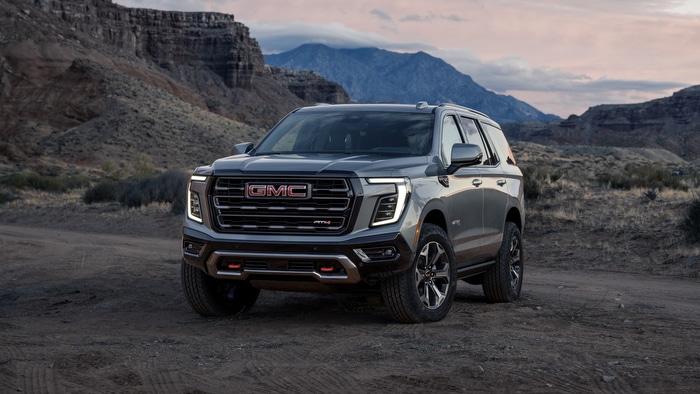
The Yukon delivers full-size capability. With a standard 5.3L V8 and 4WD, it rates at 15.8 L/100 km city and 12.2 L/100 km highway. The Yukon’s consumption reflects its size, weight, and towing capability – this is the choice for buyers who need maximum space and hauling capacity.
| Model | Engine | City (L/100 km) | Highway (L/100 km) | Drivetrain |
| Terrain | 1.5L Turbo | 9.9 | 8.9 | AWD |
| Terrain | 1.5L Turbo | 9.9 | 8.5 | FWD |
| Acadia | 2.5L Turbo | 12.1 | 10.1 | AWD |
| Yukon | 5.3L V8 | 15.8 | 12.2 | 4WD |
FWD vs AWD Efficiency
The Terrain offers both FWD and AWD on the Elevation trim. The difference is modest but measurable. FWD delivers 8.5 L/100 km highway compared to 8.9 L/100 km for AWD – a 0.4 L/100 km advantage. City consumption remains identical at 9.9 L/100 km for both drivetrains. The AWD system adds weight and drivetrain friction, which explains the highway penalty.
If you rarely encounter snow or gravel roads, FWD saves fuel without sacrificing much else. But the Terrain’s AWD system is standard on AT4 and Denali trims, and it’s the more popular choice on Elevation. The fuel economy gap is small enough that most buyers prioritize the traction advantage over the marginal savings.
The Acadia and Yukon come standard with AWD or 4WD across all trims, so there’s no FWD option to compare. GMC positions these models for buyers who need all-weather capability, and the fuel economy figures reflect that baseline.
Real-World Fuel Economy Expectations
Official ratings assume controlled test conditions. Real-world consumption varies with driving style, terrain, and weather. The Terrain’s 8.9 L/100 km highway figure is achievable on flat, steady-speed routes. Add hills, headwinds, or frequent passing, and expect closer to 10 L/100 km. City driving in winter – with remote starts and heated seats running – can push consumption above 11 L/100 km.
The Acadia’s 10.1 L/100 km highway rating holds up well on long trips with a light load. Fill the third row and load the cargo area, and you’ll see 11-12 L/100 km on the same route. The 2.5L turbo works harder under load, and fuel economy drops accordingly. City consumption can climb to 13-14 L/100 km in heavy traffic or cold weather.
The Yukon’s size and weight make it the most sensitive to driving conditions. The 5.3L V8’s 12.2 L/100 km highway rating applies to steady cruising at 100-110 km/h. Towing a trailer or driving into a headwind can push consumption to 16-18 L/100 km.
Tips to Maximize Fuel Efficiency
Smooth acceleration and steady highway speeds make the biggest difference. The Terrain’s turbo engine responds well to light throttle inputs – aggressive acceleration from stoplights can spike consumption by 2-3 L/100 km in city driving. On the highway, holding 100-110 km/h instead of 120 km/h improves efficiency noticeably.
Tire pressure affects fuel economy more than most drivers realize. Underinflated tires increase rolling resistance, which forces the engine to work harder. Check pressures monthly and keep them at the recommended PSI listed on the door jamb. This applies to all three models but matters most on the Yukon, where underinflated tires can cost 1-2 L/100 km.
Minimize idle time. Remote starts are convenient in winter, but letting the engine run for 10 minutes before driving wastes fuel. The Terrain, Acadia, and Yukon all warm up faster under light driving than sitting in the driveway. Start the engine, wait 30 seconds, and drive gently until the temperature gauge rises.
The Right SUV for Your Fuel Budget
The Terrain delivers the lowest fuel costs in GMC’s SUV lineup. If your daily driving is mostly solo commuting or light errands, the 8.9 L/100 km highway figure keeps running costs manageable. The Acadia balances three-row space with reasonable consumption – 10.1 L/100 km highway is competitive for a mid-size SUV with 328 hp. The Yukon’s 12.2 L/100 km highway rating reflects its full-size capability and towing strength.
Visit Mann-Northway Chevrolet Buick GMC in Prince Albert to compare the Terrain, Acadia, and Yukon in person.